
Sequence of return risk is an important concept to understand as you approach or enter retirement.
Simply put – Sequence of returns is the order in which negative and positive returns happen.
If you’re not taking money out, the order of good and bad years doesn’t matter—you’ll end up with the same total over a period of time not matter what order the returns happen, assuming of course the same returns each year as this chart shows.

But once you start withdrawals, it’s a different story. If the bad years hit early, your savings can run out much faster compared to starting with good years as this chart illustrates.

This is because losses combined with withdrawals make it harder for your account to recover.
To illustrate further, let’s look at the tale of two sisters retiring at different times.

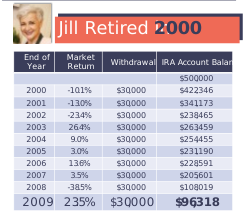
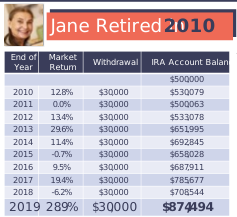
Sequence of return risk during the lost decade (2000–2010), a period of poor market performance caused many to delay retirement or forced retirees to go back to work, take less income.
While you can’t control market ups and downs, you can take steps to protect your retirement income.
They suggest strategies like the “Colors of Money“ to safeguard some assets and the “Retirement Shift“ to adjust your plan for this risk.
If you’re concerned about running out of money in retirement, let’s talk! We will set up a plan to minimize sequence of return risk!
This hypothetical example is provided for illustrative purposes only. This chart does not represent specific investment advice provided by our firm or investment results actually achieved by any portfolio of any client of the advisor or firm. Average return calculated by adding all returns and dividing by the number of years shown. Past performance is not an indication of future performance and is not guaranteed.
This material does not provide a complete description of all product features, benefits and risks. This information should not be used as the sole basis for making financial decisions.
1 Source: finance.yahoo.com – The S&P 500 Index is a stock index that is composed of the 500 largest U.S. publicly traded companies by market capitalization, or the stock price multiplied by the number of shares it has outstanding. They do not pay dividends. This is a 10-year illustration based on the historical performance of the S&P 500®. Please note, it is not possible to invest directly into the S&P 500® Index; this measure is provided solely as a benchmark of overall market performance. Past performance of the S&P 500® is not an indication of future performance and is not guaranteed.